Chapter II · Guardian Angels
The Man Who Gave Every Day of the Year an Angel
The angel linked to your birthday doesn’t come from the Bible or from medieval monks. It comes from a small book printed in Amiens in 1823, and from the remarkable man who wrote it somewhere between a velvet workshop and a secondhand bookshop.
By Alma, Guardian of Angels · 6 min read ·
A child of the Revolution
His name was Lazare Lenain, and his middle name is enough to date his birth: Républicain. He came into the world in Paris in February 1793, a few weeks after King Louis XVI went to the guillotine, at a time when newborns were readily given citizens’ names. His father died when he was eleven. At twenty-one, we find him in Amiens among Napoleon’s conscripts, the very year the Empire collapsed. He would never leave.
Velvet, books, and sixteen children
Amiens was then a weavers’ town, famous for its velvet. Lenain made his living in two ways. He worked in the velvet trade as a winder, preparing the thread for the looms. And on the Place Saint-Firmin he kept a reading room, one of those shops where, for a few pennies, people came to read the newspapers and borrow the books they couldn’t afford to buy. He also sold used books and, judging by the number of authors he quotes, read everything that passed through his hands.
He married twice and had sixteen children, five of whom died in infancy. Their names tell us better than anything what lived inside him: Agla, Abraham, Inri, Isis, Adonis. Agla is a name of God taken from the Kabbalah; INRI is the inscription placed above the cross. The last child, born in 1846, was named Marie Gabriel Raphaël Michel: all three archangels bestowed on a single child.
A man who names his children this way isn’t chasing a fortune. He’s looking for something else, and in the end he would write it down.
A small book against fear
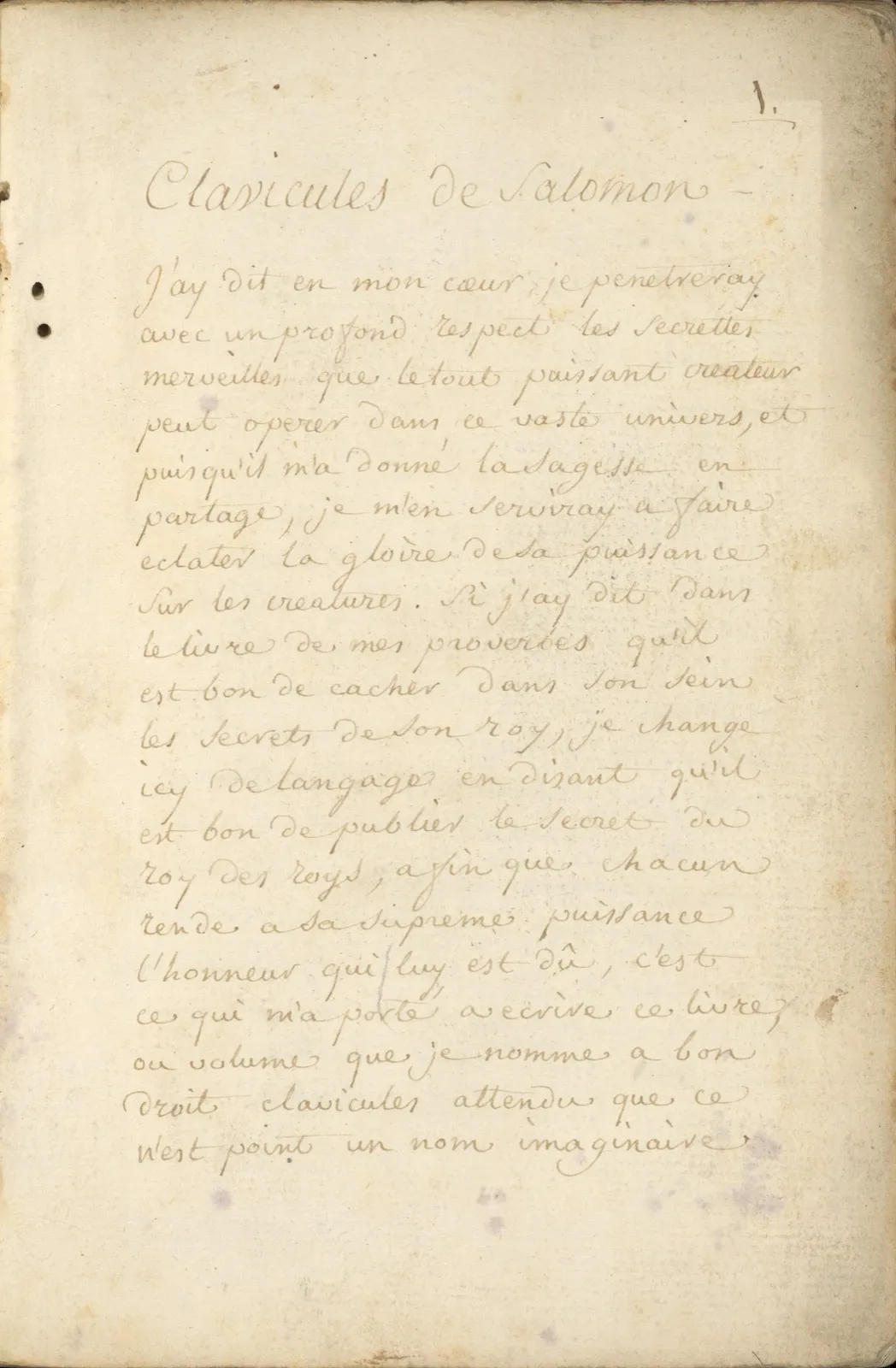
In 1823, at the age of thirty, he published it himself, from the address of his reading room: a 150-page volume with one of those endless titles people loved in those days: La Science cabalistique, ou l’art de connaître les bons génies qui influent sur la destinée des hommes. The print run was modest: five hundred copies.
Imagine what people could find on these subjects at the time. In the countryside, traveling peddlers sold cheap books of magic, such as the Grand Albert and the Petit Albert, full of recipes for casting spells or finding buried treasure. Lenain wanted exactly the opposite. He was writing, he explains, so that everyone could form a fair idea of these matters, because “ignorance demonizes everything it does not know.” The line hasn’t aged a day.
The tone of the book still comes as a surprise. Lenain writes plainly, without the jargon that weighs down learned treatises. He names the authors he relies on, something rarely done in books of this kind. And he keeps what he found in other writers apart from what he came up with himself, which is rarer still.
What he invented, and admitted he invented
This is where his story meets yours. The 72 names of angels had existed for three centuries; Lenain found them in the treatises of Agrippa and of Father Kircher, two scholars of the sixteenth and seventeenth centuries. But he didn’t find what he was looking for: none of those books says which angel watches over which day.
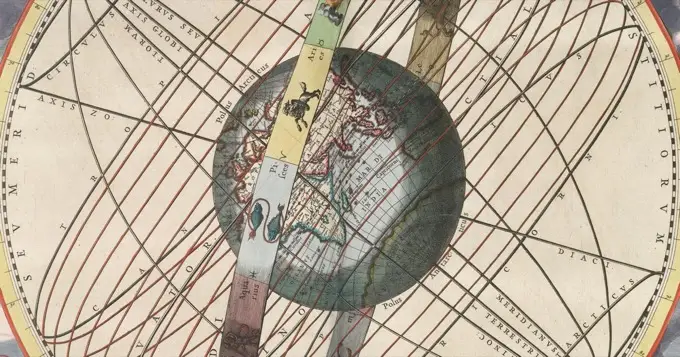
So he built it himself, and he was honest enough to say so in writing: these tables, he explains, are his own invention. He takes the circle of the year and starts it on March 20 at midnight, the moment the Sun enters Aries and spring begins. He divides that circle into 72 equal parts of five degrees. Each part receives an angel, which Lenain calls a genius, and each genius is thus given five days of the year.
He then divides the day the same way: 72 slots of twenty minutes, from midnight to midnight. To know your genius, he concludes, all you need is the day and the hour of your birth.
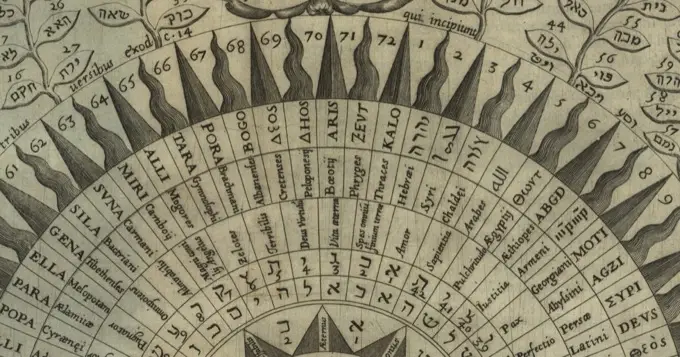
He had even planned a large engraved plate to go with the book, a “cabalistic sphere” with the 72 genii radiating out from a center. It was never printed; today, only his text lets us picture it.
A rare book, saved by its readers
With such a small print run, the book soon became impossible to find, and collectors fought over it throughout the nineteenth century. A Paris physician, Gérard Encausse, better known as Papus and a leading figure of Belle Époque occultism, rescued it from obscurity by having it reprinted in 1909. No publication, he wrote in his preface (I am paraphrasing), could better serve the study of the Kabbalah than the reprint of this treatise, which had become extremely rare.
Robert Ambelain picked it up in turn in 1951, in a book on practical Kabbalah. Then, in the 1980s, two authors born in Girona, in Catalonia, known by the pen names Kabaleb and Haziel, drew from it the books that would bring the 72 angels to a wide audience. Almost everything you read today about your “birth angel” goes back to it.
Lenain never knew any of this. He had died in November 1877, at eighty-four, in the city where the luck of the military draft had brought him more than sixty years before.
What I take from it, for you
I’ll be straight with you: the angel calendar isn’t a thousand years old. It’s two hundred. It didn’t fall from the sky. A man built it with the books he had on hand, and he said so himself, in black and white.
To my mind, that takes nothing away from it. The names are ancient: they come from the Book of Exodus and nine centuries of reading. The rule that gives one to each birth is the work of a working man from Amiens who believed everyone deserved to know their own. I find this story more beautiful than a legend, because it is true.
Lenain, by the way, didn’t stop at one angel per person: he counted three. So do we have one, or three? That’s the subject of my next article.
Sources
- Lazare Lenain, La Science cabalistique, Amiens, 1823; 1909 reprint with a letter-preface by Papus.
- Benjamin Barret, “La science cabalistique de Lazare Lenain (1793-1877),” Octagon, vol. 4, 2018.
- Robert Ambelain, La Kabbale pratique, 1951.
- Kabaleb, Les Anges, Bussière, 1989.

Alma, Guardian of Angels